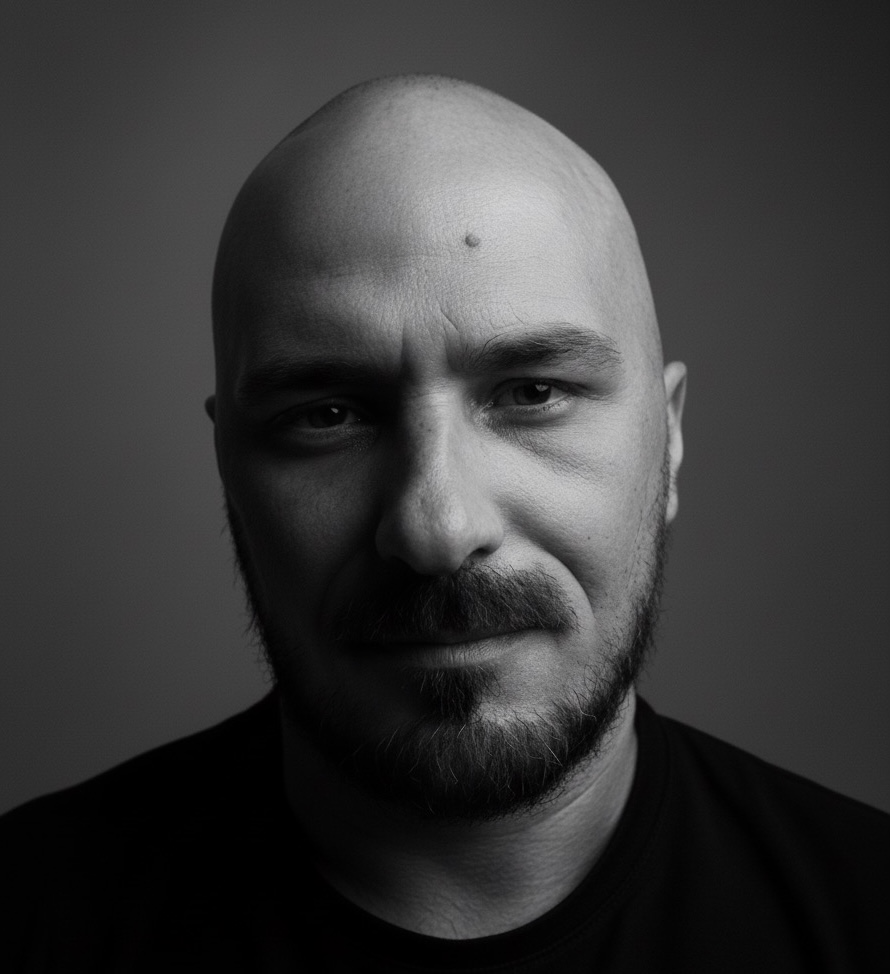
Lucas Hubert

Decision Architect.

I take the architecture of a hard decision apart to first principles, find the asymmetry, and remove the noise around it. That is the whole job.

Role
Decision Architect
Author of
Asymmetric Decisions
Works on
High-asymmetry decisions
Not
Coaching or therapy

Why the role exists

The person carrying the decision is alone

A leader with a genuinely hard decision has nobody to take it to. The team is downstream of the outcome and cannot be neutral. The board wants a position, not a doubt. Friends will comfort. A spouse carries the consequences. Everyone in the room has a stake in the answer.

So the decision gets carried privately, for months, while it quietly sets the direction of everything else. Not because the person is weak or unintelligent — because there is no structural place to put it.

That place is what I am.

Under pressure, judgment degrades in predictable ways

Decision fatigue is not a mood. It is the measurable drop in decision quality that comes from making too many choices without a structure to hold them. Under real stakes it compounds: the calendar fills, the one decision that matters keeps getting deferred, and the deferral itself starts to look like diligence.

The failure is not intelligence. It is that the decision is never separated from the noise it arrives embedded in — emotion, sunk cost, social pressure, inherited assumptions, identity.

A few decisions carry almost all the weight

Execution became cheap. Direction became scarce. In that economy a small number of asymmetric decisions determine the outcome, and the rest is noise wearing the costume of work.

Finding which decision is actually the asymmetric one — that is most of the value. Almost everyone optimizes the wrong choice beautifully.

What this is not

These are all legitimate disciplines. They are simply pointed at something other than the decision itself.

How decision architecture differs from coaching, therapy, mentoring and consulting
DisciplineWorks onWhy this isn't that
Coaching Your motivation, accountability and follow-through. A coach keeps you moving. I am not here to keep you moving — I am here to make the decision clear enough that movement stops being the problem.
Therapy Your history, and how you carry it. A therapist works on why you are the way you are. I work on the structure of the choice in front of you. Your patterns matter to me only where they are distorting this decision.
Mentoring Your path, by analogy to the mentor's own. A mentor tells you what they did. Their situation is not yours, and the analogy breaks exactly where your decision is hardest. I run a filter on your actual conditions instead.
Consulting A deliverable — the deck, the report, the recommendation. A consultant hands you an artifact and leaves the decision with you, unmade. The artifact is not the value. The closed decision is.
Decision architecture The structure of the decision in front of you. I am the objective party with no stake in which way you go — only in whether the decision is clean, named, and closed.

I do not hold space, and I will not manage your feelings about the choice. I will tell you what I actually see. That is the service.

The instruments

The Decision Filter

Five levels that take a decision from a cloud to a closed move: Recognition, Distillation, Structural Check, Selection, Movement. Levels one to four produce a decision. Level five produces a physical action in the world within forty-eight hours — because a decision nobody can observe did not happen.

It works on a $5M deal. It works on whether to send the email. The mechanics do not change.

Shadow Patterns

Six mechanisms of decision-avoidance I have watched in myself and in the people I advise: Architecture as Avoidance, Half-Open Loops, Negotiating Against Self, Over-responsibility, Confusing Pressure with Importance, Dragging Unclean Deals.

Each one is disguised as something respectable. Building the system instead of making the call looks like preparation. Revisiting the same decision looks like rigor. Naming the disguise is what breaks it.

Briefly, who I am

I spent a decade making most of the mistakes I now write about — expensively, in detail. I built a marketing agency that nearly finished me by 2016, closed it, and rebuilt my work around outcome-based economics and a refusal to sell my time at execution prices again.

I am not writing from a mountaintop. I have no unicorn and no cover story. What I have is a decade of getting lost in this specific territory often enough to know where the traps are. Polish by origin, based in Tulum, built to operate across borders.

If you want to know how I think before you decide anything, it is already published. The essays and the book contain the entire method, in public, at length.