Elon Musk thinks traditional work is dead.
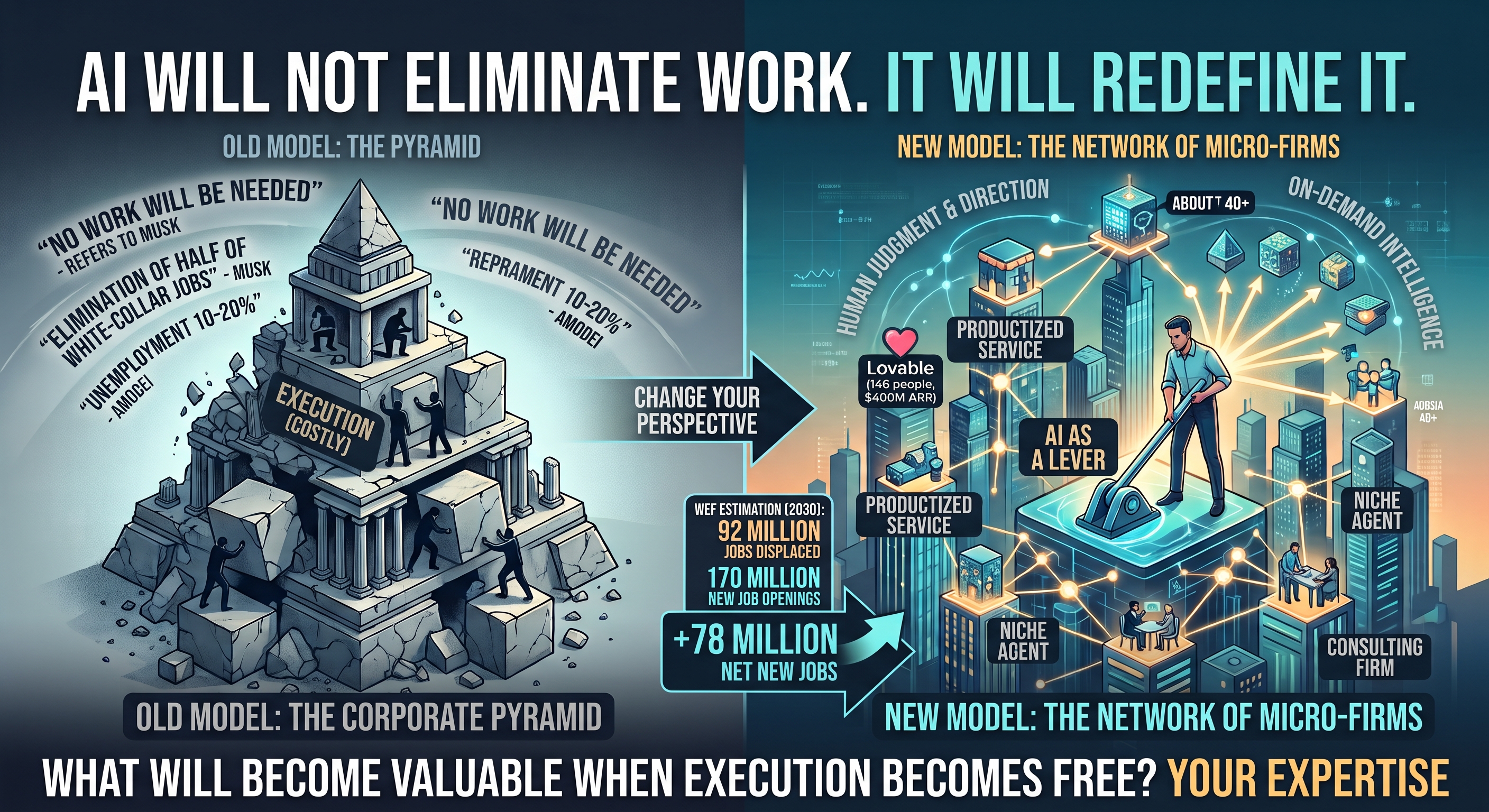
“There will come a point where no job is needed,” he recently claimed, suggesting AI will eventually do all the heavy lifting.
Dario Amodei, CEO of Anthropic, warned that AI could wipe out half of all entry-level white-collar jobs, pushing unemployment to 20% within five years.
Then there’s Jensen Huang at Nvidia, who brings it back to reality: “You’re not going to lose your job to an AI, but you’re going to lose your job to someone who uses AI.”
Three pioneers. Three different predictions. But they agree on one brutal truth: The architecture of work and business is changing. Fast.
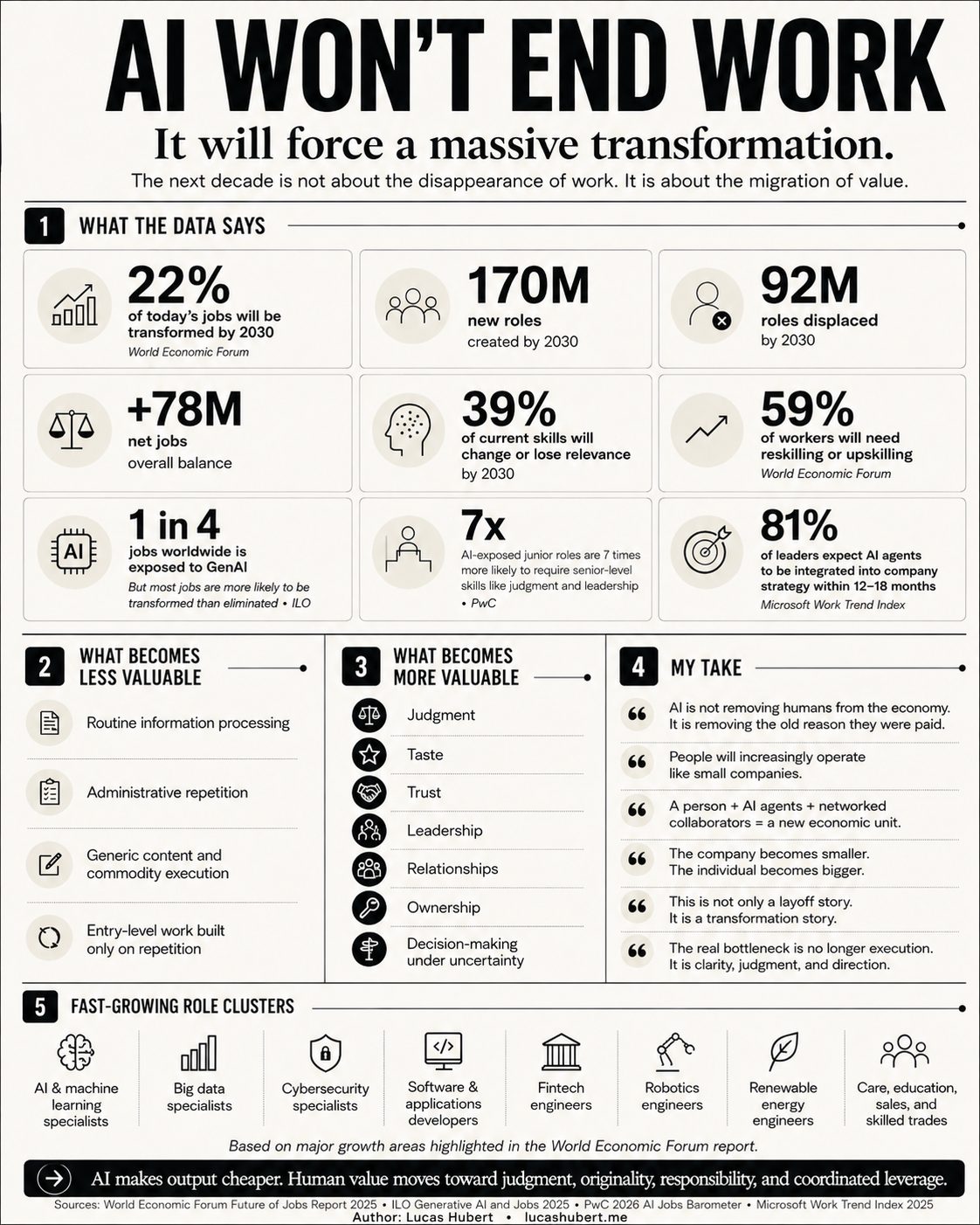
Personally, I don’t buy the “end of work” narrative. Work isn’t going to disappear. But the old way of building companies and monetizing skills absolutely will. And that distinction changes everything.
The Collapse of Execution Costs
For most of modern business history, execution was the bottleneck.
If a founder wanted to scale, they needed headcount. If you wanted marketing, software, or operations, you hired a team. You added humans to the machine. Revenue growth was directly tied to payroll growth.
AI breaks that equation.
The cost of capability is collapsing. We are moving past chatbots answering questions—we are entering the era of agents executing multi-step business workflows. But when execution becomes cheap, the Operator loses leverage. The *Architect *gains it.
If you give twenty AI agents bad instructions, you don’t get twenty times the output. You get twenty times the chaos. The scarce resource is no longer doing the work. It’s knowing what should be done, in what sequence, for whom, and why.
The Era of the Micro-Company
This is the most critical shift for founders and small business owners today.
Companies are going to get smaller in humans, but not in revenue. Look at Lovable—in early 2026, they reached $400 million in ARR with just 146 employees. That ratio used to be impossible.
Large corporations historically won because they hoarded capital, talent, and distribution. Those moats are drying up. If you run a small business today, you have access to infrastructure that previously required hundreds of employees.
This means small doesn’t automatically mean under-resourced anymore. Small means zero political friction. Fewer meetings. Ruthless speed. We are moving toward an economy of highly capable micro-companies: A few humans, a swarm of specialized AI agents, and a network of niche partners.
Why Your Expertise is Your Deepest Moat
This shift isn’t just for tech founders. It is the biggest opportunity in decades for seasoned experts, coaches, and corporate veterans looking to pivot.
For 20 years, you may have accumulated industry secrets, pattern recognition, and deep domain knowledge. In the past, monetizing that independently was a nightmare. You needed to build an agency, hire staff, and manage operations.
Today, that infrastructure is available on demand. You don’t have to be just another consultant billing by the hour. You can turn your specialized knowledge into a productized service, a decision framework, or a highly profitable micro-business. Your expertise is liquid again—you just need the right business model.
What Dies vs. What Survives
Generic execution is dead. Average analysis is dead. Coordinating people just for the sake of coordination is dead.
But as AI commoditizes execution, the human elements become premium:
Judgment and taste
Deep, un-Googleable domain knowledge
Trust and reputation
Proprietary relationships
Spotting asymmetric opportunities
AI can give ten founders the exact same data. It cannot guarantee they make the same decision. That gap in judgment is where your profit margin lives.
Don’t Defend. Redesign.
The biggest divide in the next decade won’t be between people who use AI and those who don’t. It will be between people willing to redesign their businesses (and themselves) and those praying for the old system to come back.
Don’t defend your old structure. Find your new leverage.
Look at your company, or the knowledge sitting inside your head. Can you turn that expertise into something scalable? Can agents remove 70% of the execution? Can you build a business entirely around the piece where your judgment actually matters?
So, what is your asymmetry?
I’m genuinely curious about how you are navigating this transition. Tell me what you’re building in the comments.
And if you are:
A founder or SMB owner trying to scale your business, redesign your model, and increase margins without adding corporate bloat...
An expert, coach, or consultant looking to productize your knowledge and reach a global scale...
A seasoned professional ready to pivot out of the corporate world but unsure what kind of business to build around your skills...
...send me a message. Helping people and businesses extract their true value and build highly leveraged models around it is exactly what I do.
Lucas Hubert