There has never been a better time in history to get paid for being strange.
You can run a podcast without ever setting foot in a TV studio. You can publish books without a publisher. You can write a blog, record music in your bedroom, and build a business out of the strangest things imaginable. I’m not sure there’s any point in listing the truly weird examples, like the people on OnlyFans selling their own pubic hair, so I won’t.
(Too late. I know.)
It used to be different. You had to fit into a company. Into a corporation. Into templates, rules, dress codes, and job descriptions written by someone who had never done the job.
The day I tried to become normal
A few years ago, after burning out as an entrepreneur, a thought crossed my mind for the first time in my life: maybe I could just work for someone.
It sounded like heaven. Someone takes care of me. Organizes my work. Prepares a desk. I show up, do my job, go home. A desk. A schedule. Bliss.
So I started browsing job offers, honestly asking myself where I’d want to work and what position I’d want to hold. And one giant question mark appeared in my head:
Who the hell am I?
I didn’t even know what to write. I’ve never written a CV in my life. When I tell people about my professional experience, they conclude I’m either mentally ill or making it all up. And then there’s the phrase I kept hearing: “overqualified.”
I sat with that word for a while. Overqualified. What does that even mean? That you’re too good? That you’d work too well?
After a few conversations with recruiters, it clicked. They simply don’t know how to classify me. I don’t fit any position. Any box. Any template.
So I slowly made peace with the diagnosis: I’m completely fucked up. With all the professional success, an entrepreneur since childhood, I am unemployable.
I wouldn’t survive a job in a grocery store. No disrespect to anyone who works in one. I mean it literally: I wouldn’t make it. I’m not sure I’d manage as a waiter either.
Oh, and the punchline: in the time I spent looking for a job, I founded a company and started making money. By accident. While job hunting.
Nobody has ever hired me
At some point I realized something that sounds like a brag but is closer to a confession: nobody has ever employed me. Not once. I’ve never had a salaried job. Honestly, I don’t even know how someone would hire me.
What I did instead: I created my own services, my own offers, my own job title. I built products that solved problems, and when you actually solve someone’s problem, nobody asks for your CV. It would be almost unserious if they did. You hand over the solution. Conversation over.
So I belong to the group of people who have never once been hired based on a CV. Which is convenient, because the whole CV system is now broken beyond repair anyway: people write their CVs with AI, and AI reads them on the other end. If both machines work well, maybe people get better-matched jobs out of it. Or maybe someone can now lie with surgical precision. Whatever. Not my circus.
Because this isn’t about hiring. It’s about the fact that we live in beautiful times. Times when you can earn money on your weirdness. (I promised I wouldn’t bring up the pubic hair example again, and I’m keeping that promise.)
“You’re unpredictable”
For most of my life, I assumed I was normal. Generally indistinguishable from other people.
Then one day I asked a friend why he likes spending time with me. What he actually sees in me. He looked me in the eye, thought for a moment, and said: “You’re unpredictable. I never know what to expect from you. You can’t be fitted into any template or definition. Our hours-long conversations always end somewhere I would never have guessed. Our nights out never end the standard way.”
That surprised me a little. But then I thought about it. Fine, he has a point. My life is, generally speaking, a bit messed up. I like it very much. But it is non-standard, non-linear. I get some people into trouble. Some run away from me. Others love me.
For most of my life I masked this. I tried to be nice, smooth, palatable: a polished version of myself, sanded down to fit the room. But the less I cared and the more authentic I became, something interesting happened: it scared off the wrong people and pulled in the right ones.
Authenticity, it turns out, is a filter.
Marketing in reverse
I worked in marketing for years. The job was always the same: analyze the market, learn the customer’s needs, adapt yourself to the customer.
And here’s what adapting yourself to the market actually produces: insecurity. When you contort to satisfy other people’s demand, you can never stop checking whether you still fit.
It takes balls not to adapt. To just be yourself and walk through the gate of authenticity.
Because the marketing of authenticity works in reverse. You are who you are, out loud, and the market segments itself. You say what you actually think, you do what you actually do, and your environment reshuffles. A lot of people drop off. The ones who stay are the ones who actually fit you.
You stop searching for a niche. You become one. It’s the simplest strategy there is. No market research required. Just be fucking yourself.
Everyone wonders where authenticity comes from. I know how trite the words sound. But it requires rejecting the very standards you spent your whole life trying to fit. It’s discomfort. For a while you might be invisible, because if you fit nothing, there may be a moment when nobody around you will tell you that you’re doing the right thing. It takes courage. And a certain maturity in being yourself.
My environment changed completely within a few years. At first it felt strange and lonely, and I kept pushing the threshold of my own weirdness one step further anyway. Until one day it felt good. I had finally started meeting my people. Small circle, with a good fit.
What’s left when AI does everything else
Substack is living proof that people can be themselves and earn money on their weird passions, on their original way of seeing reality. A perspective AI doesn’t have. Nobody else has it either. Only you.
In a world flooded with AI, that’s what remains: our weirdness. Our individuality, taste, unpowdered, with the wrinkles and the ugly parts. Exactly who we are.
We have so many business models and so much technology that you can invent professions, titles, and services that have never existed. The barrier to entry is embarrassingly low. And the more AI floods everything, the more valuable the one thing it can’t generate becomes.
This is the part of the article where you’re supposed to insert the Japanese Ikigai diagram. Four circles, “what you love,” “what the world needs,” purpose somewhere in the middle.
Fine. Here’s mine:
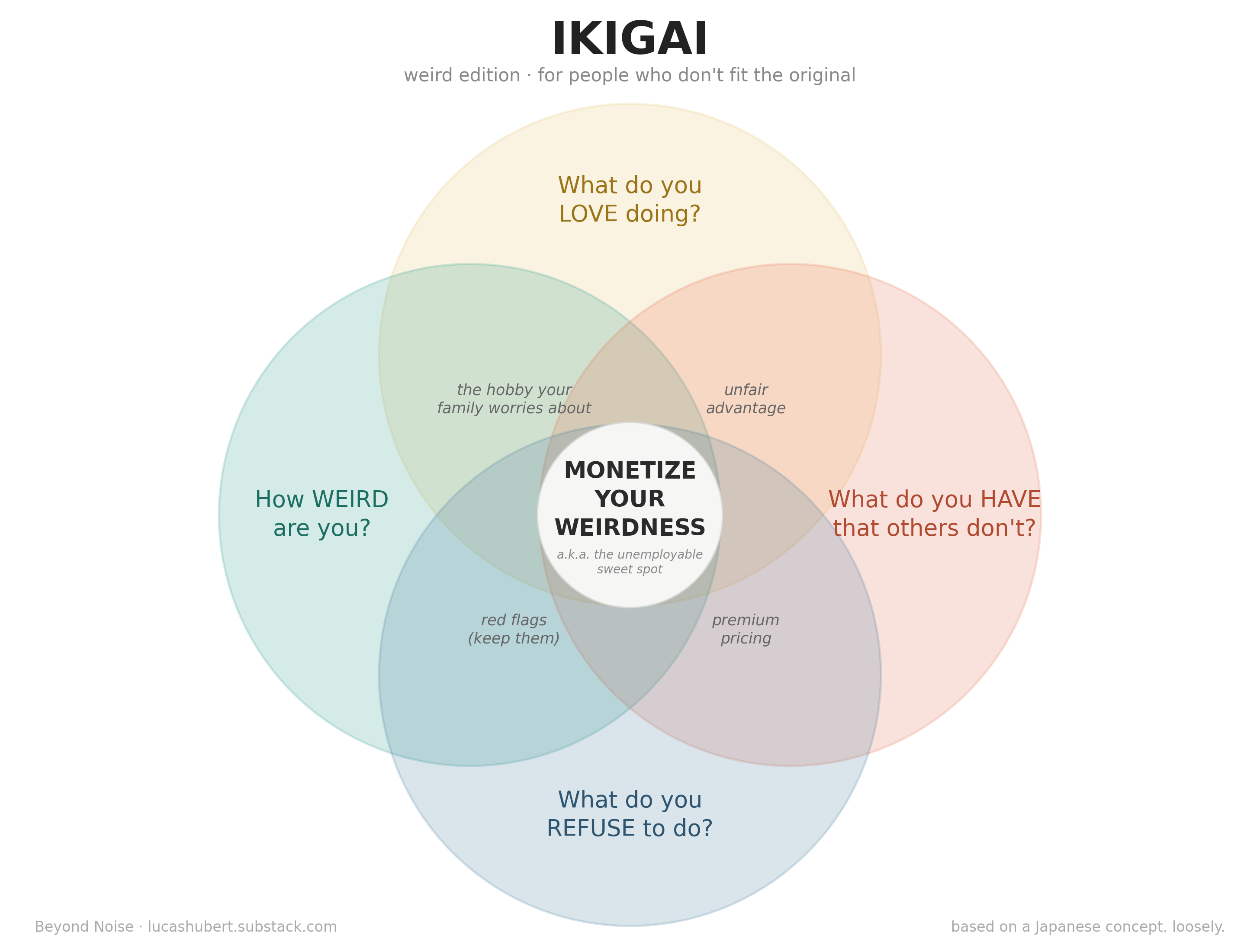
How weird are you?
What do you have that others don’t?
What do you love doing?
What do you refuse to do?
Write a comment: what can you do that others can’t?
Because that’s the whole secret: your weirdness, all of it, is your asymmetry. The thing nobody can copy, benchmark, or compete with. It’s what my book Asymmetric Decisions is about. Most of you have already read it. If you’re new here, check it out.
Lucas